WHAT ROLE DO AFRICAN YOUTH PLAY IN THE CONTINENT’S DEVELOPMENT: AfricTivistes gives a voice to young agents of change
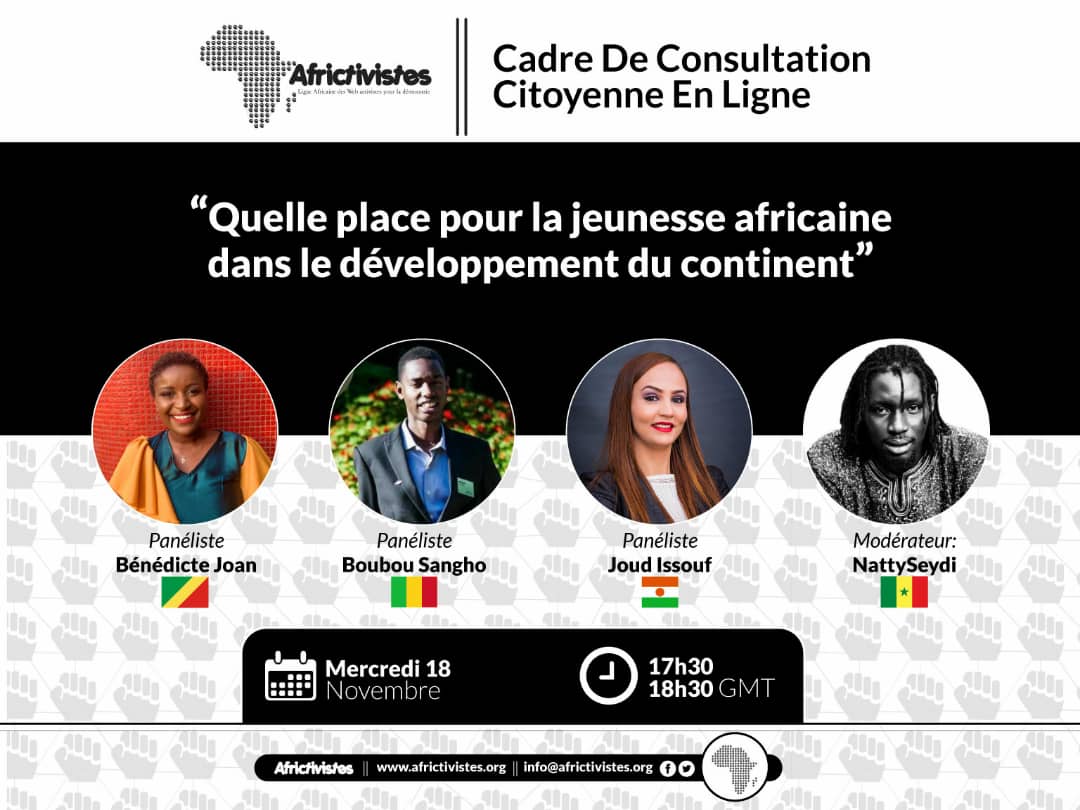
A first webinar was held on Wednesday 18 November 2020 with young changemakers selected as part of the project mapping youth initiatives to tackle the impact of COVID-19. They spoke at length about the role African youth should play in the continent’s development.
There is no shortage of young Africans ready to challenge the paradigms holding back the continent’s growth. Bénédicte Joan, Boubou Sangho and Joud Issouf are living proof. On Wednesday 18 November, these young people from Côte d’Ivoire, Mali and Niger respectively took part in the first debate organised as part of the project mapping youth initiatives to tackle the impact of COVID-19. The debate, on the theme “What role should African youth play in the continent’s development?”, was moderated by Seydina M. Ndiaye, a programme officer at Africtivistes.
Côte d’Ivoire: Bénédicte Joan praises social media activism against violence towards women during the health crisis
The debate opened with Bénédicte Joan, founder of TTWFA (Train & Travel with Women For Africa), an organisation that promotes women’s entrepreneurship in Africa through study trips. In her remarks, the young Ivorian spoke about the impact of activism in her country against violence towards women, particularly during the COVID-19 pandemic. She said the curfew had sparked conversations on social media. Some people began speaking out online about women being beaten by their husbands. “A lot of young men started saying that women should not be treated that way and that we should protect them,” Bénédicte Joan said. She added that young women had also tried to raise awareness of this violence through social media. This, she said, was also a way to give women the space to speak out, report abuse and even take the perpetrators to court.
Mali: Boubou Sangho explains how COVID-19 brought young people’s ingenuity to the fore
Boubou Sangho is a young Malian entrepreneur with a master’s degree in business law from the University of Legal and Political Sciences of Bamako. He is CEO of “Boubou Lait”, a business that processes and preserves fresh local milk, turning it into other products. He is also project manager at “Les Leaders de demain”, an organisation that trains young people in leadership, entrepreneurship and personal development.
Speaking on Wednesday 18 November 2020, he described the many solutions young people in his country had created to tackle the novel coronavirus pandemic. These included handwashing machines, disinfection tunnels, ventilators and mobile apps that work without an internet connection and in national languages. Young people had also been regularly sharing essential information about COVID-19. “It is true that we cannot be pleased about this pandemic, but it has given young Africans, and young Malians in particular, an opportunity to show what they can do,” said Boubou Sangho. He also called for greater advocacy around entrepreneurship. He mentioned a document submitted to the National Assembly containing proposals on how to help young people start and run businesses more successfully, as well as establish a support fund for young Malians.
Niger: Joud Issouf discusses education challenges in a country where literacy is below 20%
Joud Issouf is a businesswoman based in Niamey who works in business consultancy and interpretation and translation. Through her company, “Global J Services”, and in partnership with the NGO “REINES DAURA”, she provides moral and educational support to young women sponsored by the organisation, offering them free English lessons to help broaden their skills. She is active in campaigns to promote girls’ education and combat forced and early marriage in Niger.
Speaking at the webinar on the role of African youth in the continent’s development, Joud Issouf began by welcoming the way the COVID-19 pandemic had been managed in Africa. In her view, the way young people got involved at the start of the health crisis showed that Africa was the continent of the future. Among the initiatives in her country that impressed her most was one run by an association of young women who had learned to make hand sanitiser and masks.
However, she believes that the challenges remain enormous overall. She called for more education for people across all communities. At the height of the COVID-19 crisis, she explained, some people in her country had to be taught how to wash their hands and use masks. “There was also a lot of fake news, particularly about how effective chloroquine was. Some people even started taking it without doctors’ advice,” she said.
On politics, Joud Issouf noted that Niger would soon hold a presidential election. She said it would take a man like Seyni Kountché, Niger’s second president after independence, to fulfil the country’s development aspirations. She disagrees with investment in Niger being directed solely towards infrastructure at the expense of more essential areas such as education. She deplores the fact that the literacy rate in her country is below 20%. “It is abysmal,” she added. Joud Issouf said that until these kinds of problems are resolved, “we could have entrepreneurs, volunteers and social workers, but we will not get far”.
In her view, Niger’s next president in 2021 should be a dictator in the positive sense of the word. She pointed to President Seyni Kountché, who used to make unannounced visits to government offices to see who was at their post and who was not. She lamented that “nowadays, at 10 am, you can find a civil servant out in the street eating grilled meat. We need a dictator who will enforce respect for the law and professional discipline.”
She also believes women should have a greater role in society and in Niger’s decision-making bodies. “Women face discrimination. They are not sufficiently represented in government. I am also preparing a novel that will be a heartfelt cry about the place reserved for women in Niger,” she announced.