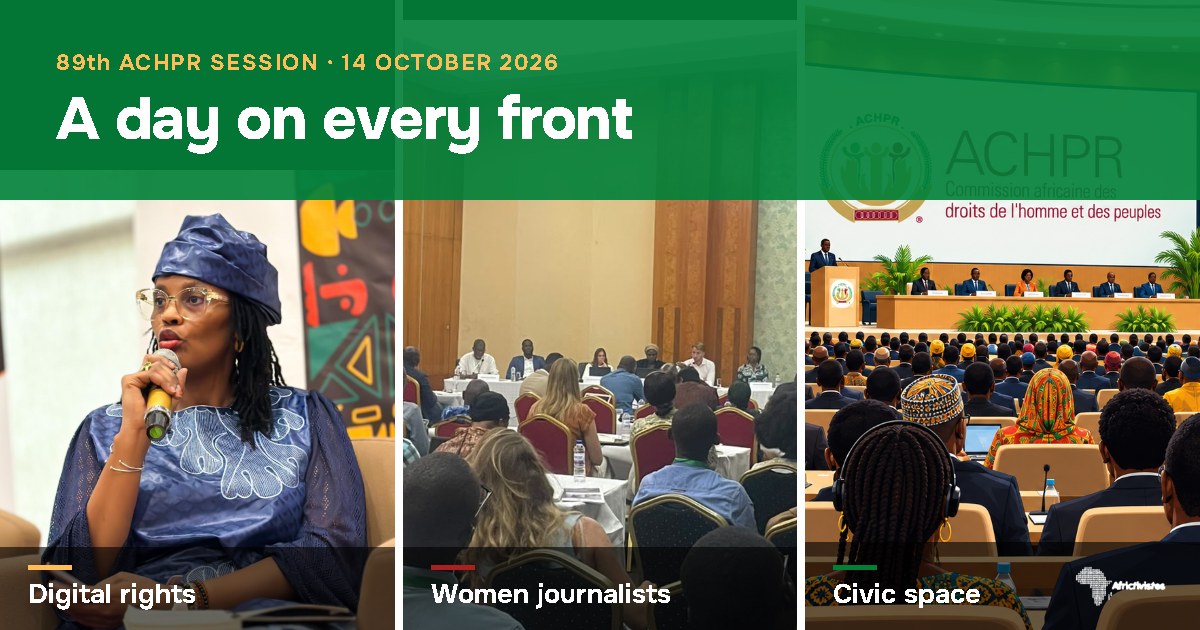
Women’s rights in Africa: in Dakar, social movements call for better protection of women activists
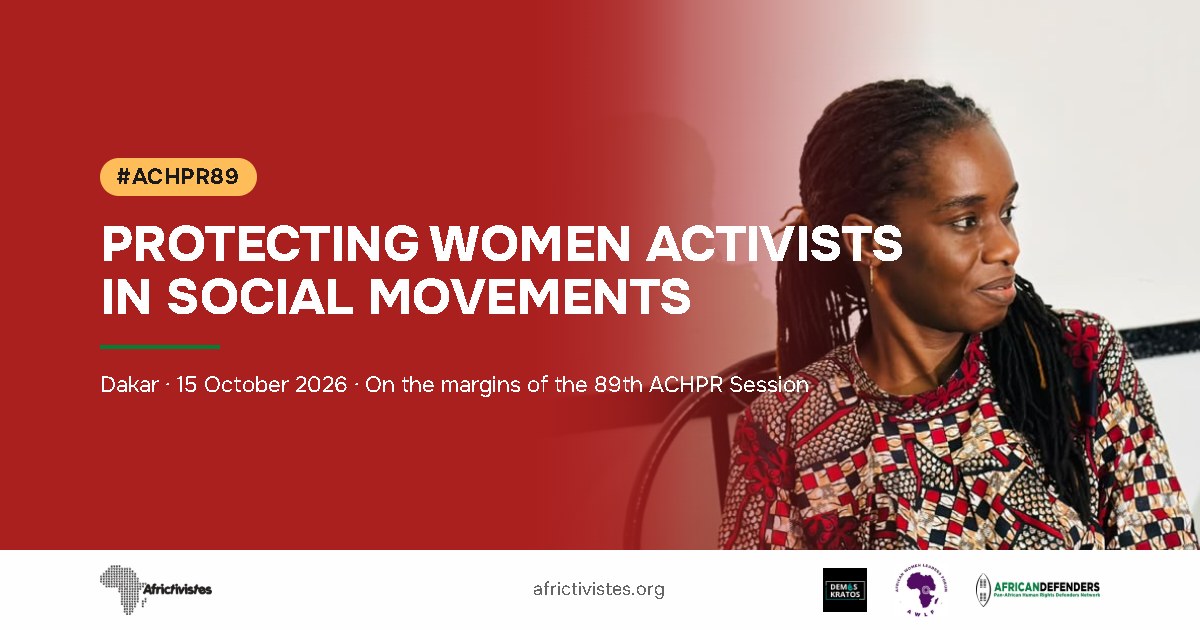
Gathered on 15 October 2026 in Dakar, on the margins of the 89th session of the African Commission on Human and Peoples’ Rights (ACHPR), women activists and human rights defenders denounced the violence and discrimination targeting women engaged in social movements. They call for stronger protection mechanisms and greater inclusion of citizen movements.
Organised by AfricTivistes, Demos Kratos, the African Women Leaders Forum (AWLF) and AfricanDefenders, the meeting “Rising to the Moment: Protecting Young Women in Social Movements” provided a space to discuss the threats women activists face, in public spaces and online, and ways to better protect their rights.
The meeting did not start from scratch. Two webinars were held beforehand: the first on the engagement of women from Kenya, Senegal and Eswatini in social movements, the second on the experiences of Senegalese women and the formulation of recommendations for the ACHPR. These discussions were complemented by contributions to AfricTivistes’ pan-African citizen consultation, which devotes a theme to the protection of young women leaders in social movements.
Women activists facing violence and discrimination
Binta Diallo, a member of the Senegalese citizen movement Y’en a Marre, stresses that the obstacles women face are rooted in cultural and social factors. Despite these difficulties, they develop their own strategies to cope with violence and pressure.
“Women within the movements find their own solutions to the problems they face in public space and in cyberspace,” she explains. Awareness-raising, training, psychosocial support: the challenge is to “remain steadfast without losing ourselves or giving up”.
A Kenyan activist spoke of the risks linked to protests, including police surveillance practices and enforced disappearances. She also highlighted the difficulties faced by victims who, lacking visibility on social media, struggle to make the violence they suffer known. She called for rethinking regional protection mechanisms, which she considers poorly adapted to women’s realities, and recalled that access to justice requires resources many women do not have: justice delayed is justice denied, and procedures must be simplified.
An activist from Eswatini, for her part, denounced the silence of some men in the face of gender-based and sexual violence within citizen movements themselves, and urged them to speak up.
Mental health and the next generation of activists
President of the Wa Mbedmi Association and co-founder of Sénégal Vote, Jaly Badiane points to a civic space that has become more hostile to women, online and offline, and to the growing difficulty of passing the torch to new activists. “How can we make sure, within our social movements, that the generations coming up do not experience the same situation? Intergenerational dialogue is essential,” she asks.
She also warned of a blind spot: “For a long time, the mental health of women human rights defenders was neglected, especially in the face of digital violence.” Hence her call to co-build support mechanisms.
Documenting violations to obtain justice
Through his mandate, Commissioner Rémy Ngoy Lumbu, ACHPR Special Rapporteur on Human Rights Defenders and Focal Point on Reprisals in Africa, regularly receives information on restrictions on civic space, the harassment of defenders and gender-based violence. “These attacks can reach anyone and strike entire families. Their consequences are even heavier when young people are involved,” he stresses, before recalling the continent’s commitment: “This is not the Africa we want. The African Union’s Agenda 2063 places women at the centre.”
He made clear, however, that the Commission does not itself administer justice: accountability must first be sought before national courts, before turning to regional mechanisms, in accordance with the applicable rules.
“The most important thing is to document violations of human rights and women’s rights, and to go before national courts before taking cases to the Court,” he recalls.
He also expressed concern about the situation of human rights defenders in crisis contexts, where activists and feminists are exposed to the risk of persecution.
The Special Rapporteur also warned of the changes artificial intelligence could bring to the work of defenders: “Artificial intelligence will turn our work as human rights defenders upside down. Perhaps tomorrow there will be a humanoid special rapporteur.”
While these technologies can make it easier to document violations, they also raise concerns about surveillance, information manipulation and the protection of people at risk.
Making African mechanisms more accessible
For Joseph Bikanda of AfricanDefenders, protecting human rights requires better knowledge of African legal instruments. As the African Charter marks the 40th anniversary of its entry into force, he raised a fundamental question: “We are celebrating 40 years of the African Charter, but do we know whether it resonates with the people?”
“We must ensure that the African Charter is accessible to as many people as possible across the continent, and to do so, we must go through education, awareness-raising and advocacy,” he stresses.
For her part, Aisha Dabo, Programme Coordinator and co-founder of AfricTivistes, calls for turning lived experiences into concrete recommendations for the African Commission, with greater inclusion of non-conventional citizen movements.
“We must move from lived experiences to strong recommendations for the Commission, and to do so, we must seize opportunities to include non-conventional movements in advocacy at the level of the Commission,” she said. Youth movements, informal collectives, online activists: they too must be able to bring their recommendations before the ACHPR.
This Dakar meeting thus highlights one requirement: beyond the texts, protecting women activists calls for accessible mechanisms, better consideration of gender-based and sexual violence, and the effective participation of social movements in protection policies.
This meeting is the second of the three activities AfricTivistes is co-organising on the margins of the session. The last one, on Friday 16 October, focuses on civic space under pressure in the Sahel and West Africa, with WACSI and RFLD.