‘Arbitrary’ suspension of Twitter in Nigeria
AfricTivistes welcomes the ECOWAS Court’s ruling and calls for a more proactive approach in its decisions
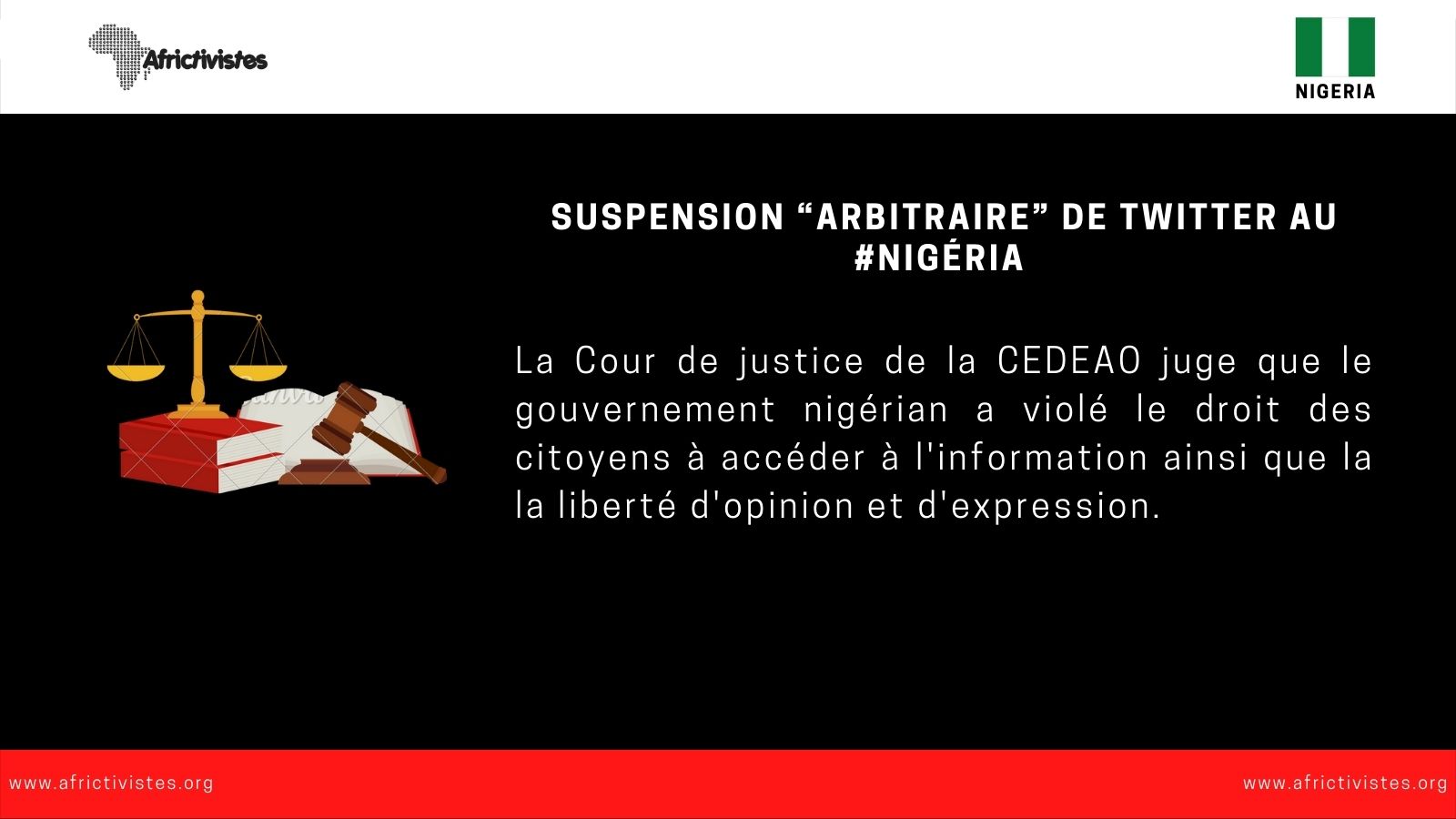
On Thursday 14 July 2022, the Court of Justice of the Economic Community of West African States (ECOWAS) handed down a ruling concerning the Nigerian government’s decision to suspend the social media platform Twitter in June 2021 following the removal of a tweet by President Muhammadu Buhari that incited hatred.
The Court finds that the government has violated Nigerian citizens’ right to access information, as well as their freedom of opinion and expression, as enshrined in Article 9 of the African Charter on Human and Peoples’ Rights (ACHPR) and Article 19 of the International Covenant on Civil and Political Rights.
The suspension of the social media platform also infringed the claimants’ rights to freedom of expression and to access to information and the media, according to the Court, which ordered the Nigerian Government to take legislative measures to safeguard the claimants’ rights and to pay their legal costs.
This ruling follows a complaint lodged in July 2021 by citizens and human rights organisations against the State, which had suspended the social media platform in Nigeria.TheNigerian government maintains that by removing President Muhammadu Buhari’s tweet from its platform, Twitter was taking sides with the secessionists in the south-east of the country. It should be noted that the tweet in question referred to the Nigerian Civil War of 1967–70 and the need to deal with “those who misbehave today” in “a language they will understand”.
This suspension lasted seven months until Twitter agreed, in January 2022, to register as a company in Nigeria and pay local taxes following negotiations.
It has been observed that an increasing number of African countries are attempting to control social media by introducing laws designed to restrict freedoms or by raising taxes to discourage citizens from using it. It is no secret that social media has democratised freedom of speech and expression in Africa.
In 2021 alone, the KeepItOn Coalition’s report on internet shutdowns reveals that the number of shutdowns rose from 159 in 29 countries in 2020 to 182 in 34 countries in 2021, predominantly in Africa, for various reasons: education, security, elections, protests or alleged security reasons.& nbsp;
Between 2010 and 2021, many African countries adopted or drafted laws aimed at restricting social media or tightening censorship, often justifying these draconian laws on the grounds of protection against cybercrime.
The ruling handed down by the ECOWAS Court is the second of its kind relating to the internet, following the 2020 ruling which declared the internet shutdown in Togo during the 2017 protests to be unlawful and ordered the Togolese state to pay a fine.
AfricTivistes regrets, however, that this decision has come a year after the events took place. Whilst we understand the delay in the decision-making process, we believe that the Court’s decision should have been taken long ago and that it should have been accompanied by stringent sanctions to deter states from adopting such positions.
AfricTivistes believes that rapid mechanisms are therefore needed to deal with such matters, which are considered urgent.
AfricTivistes is therefore calling on the Court to be more proactive, as more and more states in the region are seeking new ways to infringe upon their citizens’ rights on the internet by adopting further repressive laws under the guise of combating terrorism, or by imposing taxes on the use of social media platforms to discourage their use.
However, AfricTivistes welcomes the Regional Court’s rulings in the Togo and Nigeria cases. We believe they confirm that internet rights are human rights.
Ultimately, we call on the Court to remain vigilant with regard to the most flagrant violations involving internet shutdowns, censorship, cyber-surveillance and breaches of personal data by African states.